

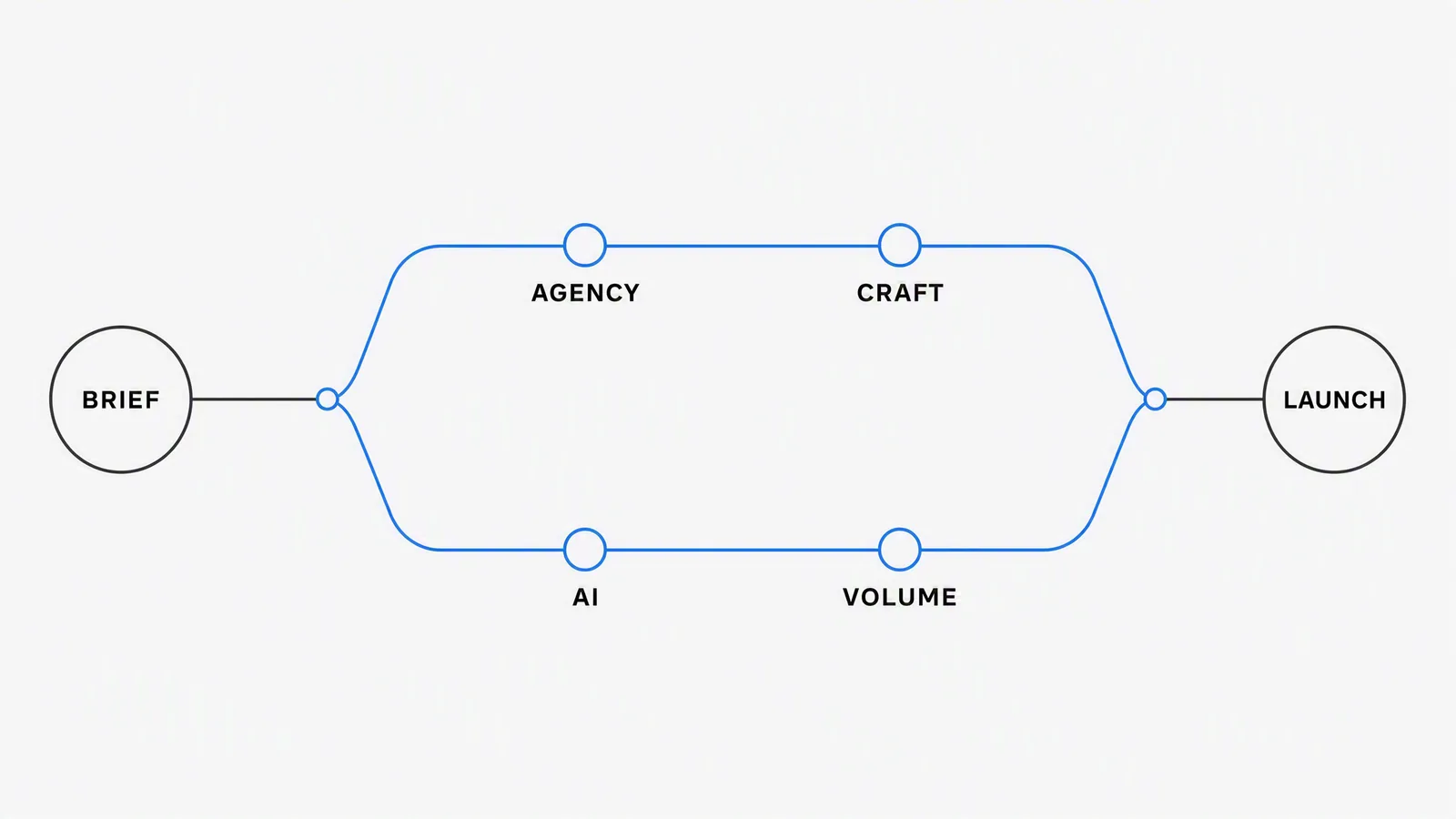
Hire a video ad agency when the scarce input is strategy, original footage, talent, production craft or external accountability. Use an AI workflow when the direction is known and the scarce input is the capacity to produce and adapt more campaign video. Use both when one hero production needs many follow-on variations.
A video ad agency can be cheaper than a failed self-serve process, even when its invoice is larger. An AI tool can be far more efficient than an agency retainer, even when a human still reviews every output. The decision depends on scope.
Key Takeaways
- The choice between a video ad agency and an AI workflow comes down to which input is scarce: original craft and accountability, or iteration volume and speed.
- A fair cost comparison requires normalizing the scope first: match what is included (concepting, filming, talent, revisions, rights) before comparing a quote to a subscription.
- A hybrid model, one original production followed by AI-generated adaptations, fits teams that need both a trusted hero asset and fast follow-on variations.
Quick verdict
|
Choose |
Best fit |
What you still need |
|---|---|---|
|
Video ad agency |
Original shoots, performers, creator relationships, complex storytelling, specialist direction and managed delivery |
A clear brief, budget and approval owner |
|
AI production workflow |
Product videos, voiceover or faceless formats, UGC-style concepts and repeated variations from existing sources |
Verified inputs, human selection and final review |
|
Hybrid |
Hero shoot or campaign platform followed by many channel adaptations |
A defined handoff and consistent rights |
Pricing: normalize the deliverable
Clutch's July 2026 pricing guide reports that reviewed video-production projects typically cost less than $10,000, with an average project cost above that figure and commonly reported agency rates of $100–$149 per hour. It also identifies crew, timeline, location, talent, animation and special effects as material cost drivers. Those figures describe managed production, not a subscription for generated clips.
|
Cost layer |
Agency |
Advibly self-serve workflow |
|---|---|---|
|
Access |
Project fee, retainer or hourly rate |
Create $29/month; Publish $59/month, checked 4 Aug 2026 |
|
Production inputs |
Crew, locations, equipment, talent and post-production as scoped |
Existing product sources, references, selected model and generation credits |
|
Video generation |
Included only as contracted |
Current internal estimate is roughly 14 videos on Create or 19 on Publish, depending on model and format |
|
Human work |
Agency team can own direction and delivery |
Client team owns brief, selection, claims and approval |
|
Rights |
Must be negotiated for talent, music and footage |
Source and generated-asset rights still require verification |
A worked monthly scenario
Suppose a product team needs four net-new 15-second concepts and three adaptations of each: 12 delivered variations. Compare proposals against the same requirement.
- Agency scope: confirm whether concepting, script, filming, talent, edit, captions, music, three aspect ratios, revision rounds and usage rights are included.
- AI scope: include subscription, generation credits, rejected attempts, source preparation, voice or music rights, editing and internal review time.
- Hybrid scope: commission one or two original concepts or shoots, then use an AI workflow for bounded variations and new channel treatments.
A per-video calculation is meaningful only after those inclusions match. Dividing a full-service production quote by the number of final files and comparing it with generation credits alone understates the human work in the AI path.
Capability comparison
|
Capability |
Agency |
AI workflow |
|---|---|---|
|
Original footage and exact performance direction |
Strong |
Not the core fit |
|
Creator sourcing and contracting |
Available when offered |
Outside the workflow |
|
Reusable product context |
Lives in agency knowledge and briefs |
Can remain available across runs |
|
Rapid message and format variants |
Depends on scope and turnaround |
Strong after direction is approved |
|
Creative accountability |
Can be contractually owned |
Remains with the client team |
|
Campaign measurement |
Sometimes included as a separate service |
Lives in the ad or analytics platform |
Where Advibly provides higher value
Advibly is a fit when a team already has product truth, a message and someone who can approve the work. It can start from websites, stores, app listings, screenshots, product images and brand assets; preserve reusable context; produce product, UGC-style, faceless or voiceover-style video; and carry the direction into related image and social formats. The workflow shows generation usage before the run.
That is higher value for repeated production. It is not higher value than an agency when the real need is a director, crew, actor, location, original customer testimony or someone else to own the campaign.
Final decision
Buy an agency for expertise and managed production. Buy an AI workflow for controlled volume and fast adaptation. Buy a hybrid when original human production creates the trust and AI extends its useful life.
Explore self-serve video production in Advibly.
Sources
- Clutch Video Production Pricing Guide 2026, updated 28 July 2026 and accessed 4 August 2026.
- Advibly pricing, checked 4 August 2026.
- Advibly AI UGC video workflow, checked 4 August 2026.