

HeyGen, Descript, Runway and Advibly are worth evaluating when your video job calls for a different presenter workflow, editing real recordings, generating cinematic shots or producing a multi-format campaign. They are not automatically better than Synthesia. Keep it when its avatar-led lessons, updates and localization already meet the requirement.
Start by naming the work you want to replace. Turning a policy script into a presenter video, cutting an actual interview and creating an atmospheric product shot are different tasks. A convincing sample from one task tells you little about whether a tool can replace the others.
Match the replacement to the job
This shortlist uses official product and billing information checked September 12, 2026, plus Advibly's maintained capability reference. The tests below are proposed evaluations, not experiments we performed. No output-quality ranking, savings benchmark or tested translation-accuracy claim is implied.
|
Production bottleneck |
Evaluate this route and test this outcome |
|---|---|
|
Speaker delivery or localization |
HeyGen against your existing Synthesia workflow. Test the consenting person's likeness, terminology and a real revision. |
|
Turning recordings into a coherent edit |
Descript. Import actual source media, produce the required cuts and verify the meaning survived editing. |
|
Creating or transforming a visual shot |
Runway. Test the specific model, reference and motion, then place the result into the finished sequence. |
|
Keeping a product campaign consistent across formats |
Advibly. Carry approved product context through the creative set and its publishing handoff. |
|
Updating repeatable presenter-led lessons |
Stay with Synthesia if the existing process still passes the learner, reviewer and delivery requirements. |
Several products overlap. A tool's presence in one row does not mean it cannot serve another; the row identifies the reason to evaluate it here.
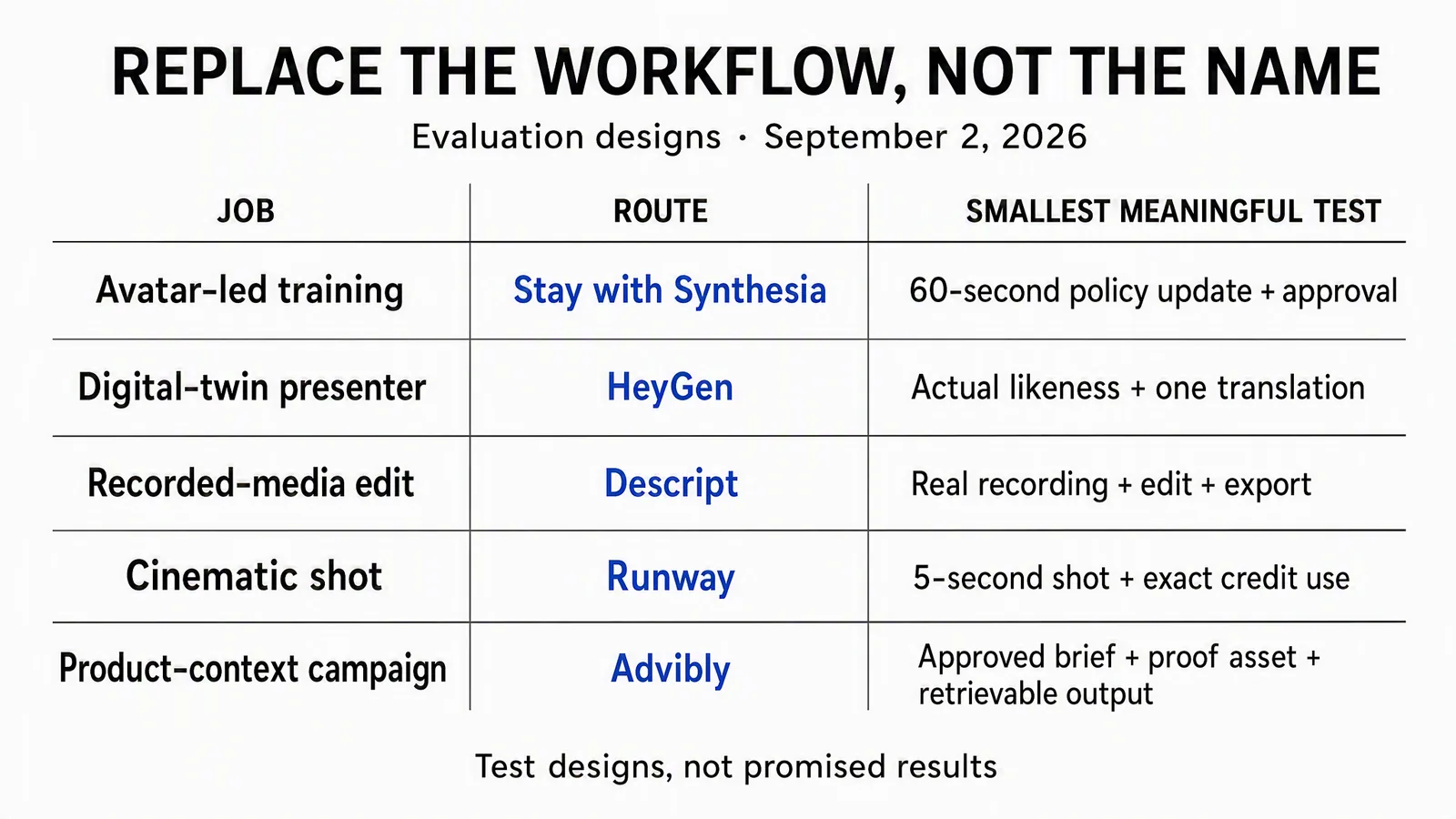
Preserved evaluation map from September 2. These are starting tests, not completed benchmarks. A five-second shot must also pass the editing handoff; one retrievable campaign asset does not prove a complete multi-format campaign.
What a non-presenter alternative actually looks like
Here is the difference between changing the presenter and changing the format. In this existing Advibly demonstration, Coffeeverse's real product source becomes a paper-collage explanation. The product stays recognizable while the surrounding scene carries the story. That is relevant when a product idea needs explaining visually; it is not a reason to discard a working presenter-led course.
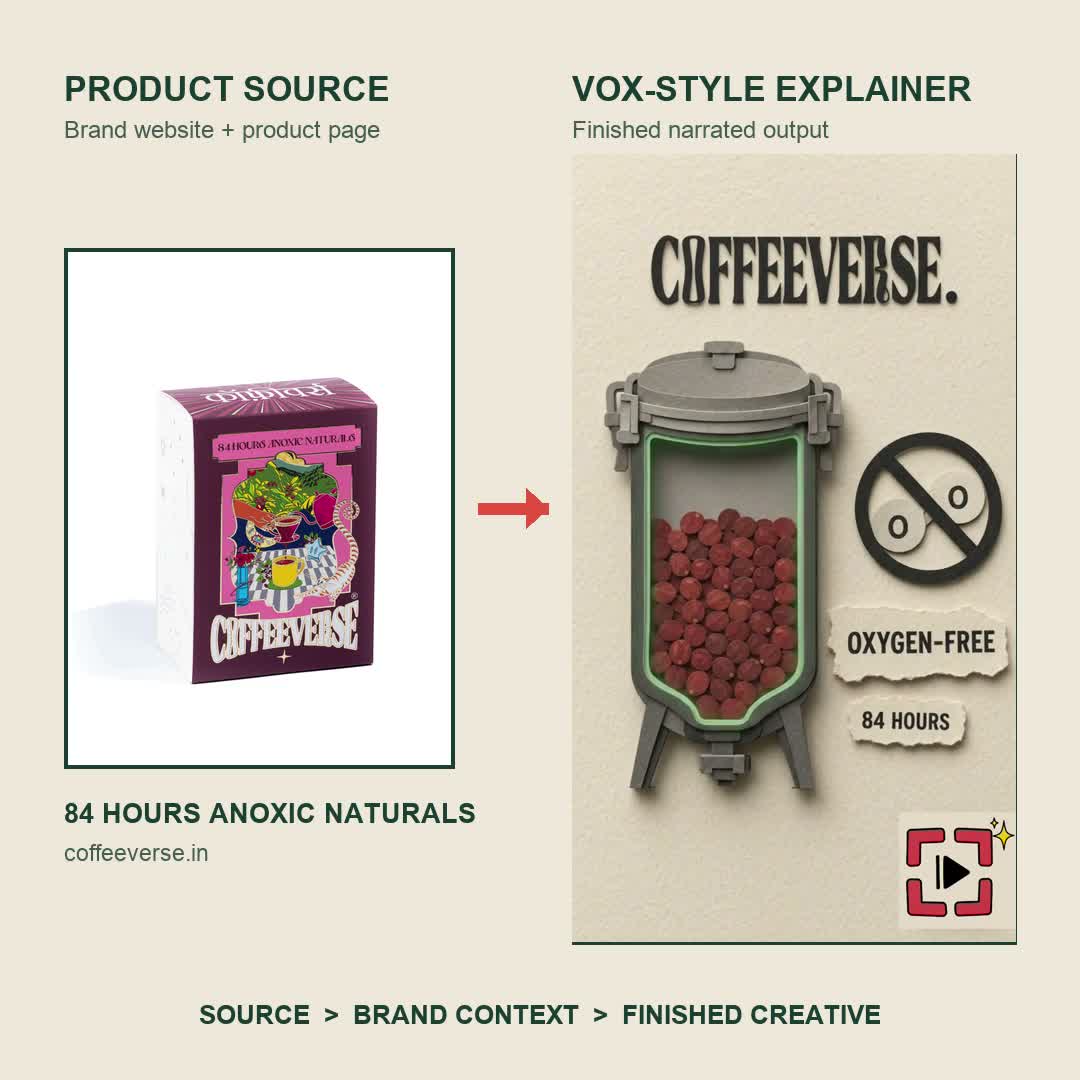
Still from an existing Advibly source-to-output demo, not an interactive player. Product source at left; illustrative explainer frame at right. This is not a Synthesia result, real production-process footage, customer endorsement or output-quality benchmark.
To make the corresponding Advibly brief, begin with a product URL, an approved product image and one claim supported by the source. Use a beat map to decide what the audience must understand, review the collage images, then create motion and narration and check the assembled film. Preserve the source pack instead of accepting a generated replacement label. The current skill describes the workflow; this refresh reuses an existing result, not a newly executed test.
See the paper-collage explainer workflow and example.
The switching test changes with the job. For this format, test story clarity, source fidelity, editability and the finished cut. For a Synthesia lesson, test the presenter, language review and learner handoff. Do not score a cinematic product scene against SCORM delivery and call either tool the winner.
Before switching, separate a workflow problem from a plan problem
If the problem is simply running out of capacity, inspect the actual consumption first. Synthesia's current credit reference lists Starter at 1,200 monthly credits and editor video generation at two credits per second. That arithmetic is 600 generated seconds, or ten minutes, before other consumption. The monthly minute description is not inherently contradictory. Dubbing, API generation and other assets have different rates. Synthesia credit reference.
The distinction is generated work versus approved output. Changed narration or other chargeable operations can use more capacity, while some edits add no credit charge. Diagnose the operation and revision pattern before deciding the platform itself is wrong for the job.
Annual figures need more care. The public selector advertises 120 and 360 video minutes for annual Starter and Creator, while the credit guide lists balances of 14,500 and 44,000. Straight division produces slightly different theoretical capacity. Treat the advertised allowance and actual account limit as the buying boundary, not permission to promise extra usable minutes. Pricing; credit documentation.
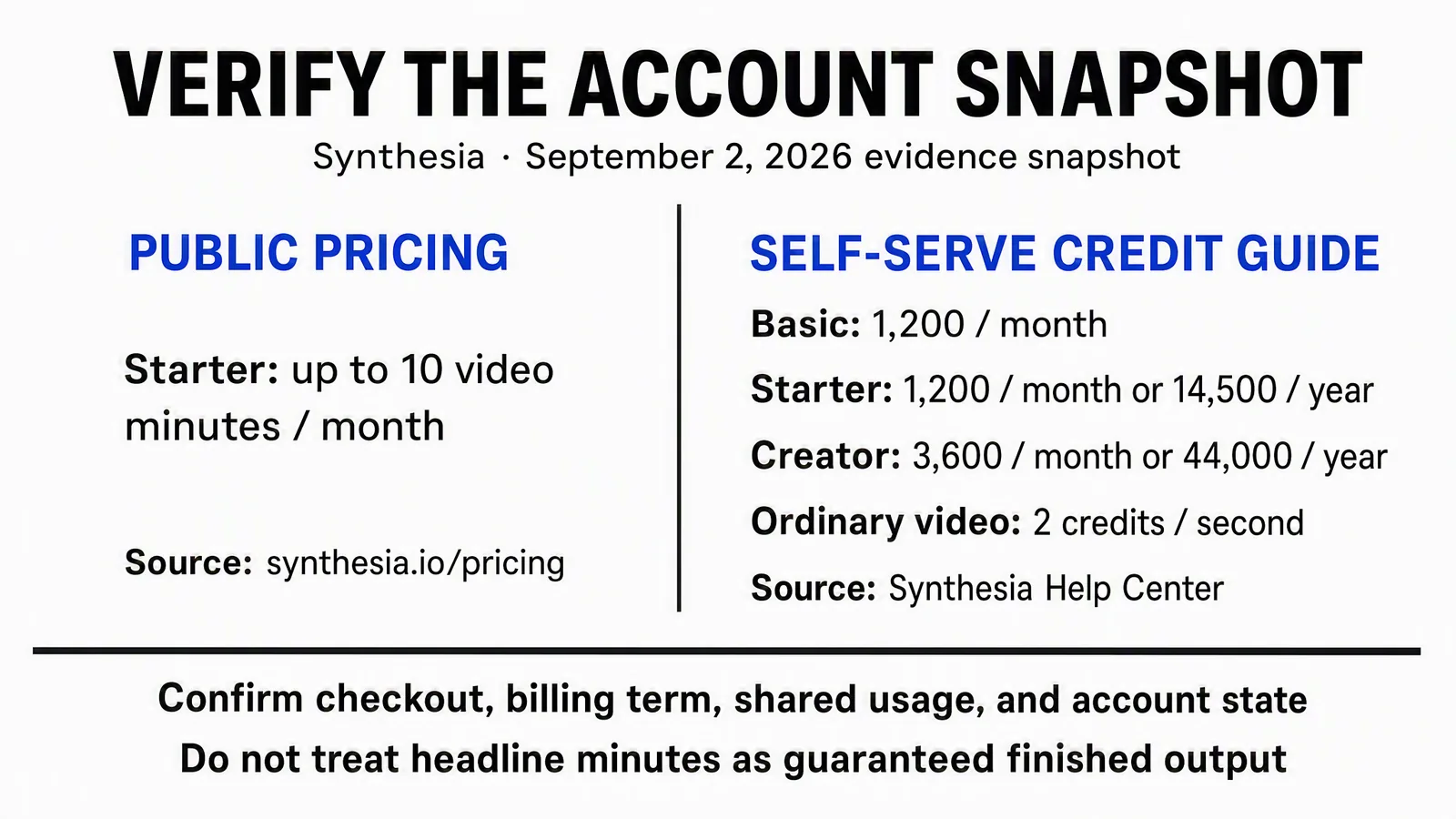
Historical source-comparison card. Its “ordinary video” rate should be read as editor video generation, not all operations. The monthly 1,200-credit and ten-minute descriptions reconcile at two credits per second; the current annual and shared-use qualifications are explained above.
1. HeyGen: compare the exact presenter and review experience
HeyGen offers custom avatars, voice cloning and translation workflows. Its public Creator offer lists $29/month with 600 monthly credits; eligible higher plans add different export and team features. Those are plan facts, not proof that its avatar output is more convincing for your speaker. HeyGen plans.
Synthesia also offers Personal Avatars on Starter and above, created from a real person's image or footage with explicit consent. Don't move to HeyGen on the assumption that Synthesia can only provide stock presenters.
A representative test: use a consenting spokesperson's approved introduction with one difficult product name, one number and a natural pause. Produce the required language version, ask an appropriate reviewer to assess the meaning and delivery, then change a factual sentence. Record the setup, review and correction work in both systems using the relevant account settings.
Choose HeyGen if that specific workflow is a better fit. Stay with Synthesia if the current avatar, terminology and update process already works and recreating those assets adds work without a useful improvement. Do not assume an avatar or cloned voice transfers between accounts or vendors; verify portability and permission before making migration depend on it.
2. Descript: edit the recording you actually have
Descript is a relevant alternative when the source is an interview, podcast, screen recording or talking-head recording that needs editing. Its video-editing workflow uses transcription and text-based edits alongside a timeline, captions and audio tools. It also offers generated media and avatars, so “editor” is a workflow emphasis, not a claim it lacks generation.
For a recorded interview, select a passage that contains a retake, a qualification and a useful answer. Cut the retake, keep the qualification and produce the target excerpt. Listen to the result without reading the transcript: a tidy text edit can still sound abrupt or remove the context that made the statement accurate. Check caption timing, names and the final export.
Choose Descript when editing real material is the core work. Rebuilding a real interview as synthetic narration is not an equivalent replacement if the purpose is to preserve the speaker's actual account. Conversely, importing recordings is not a requirement for every Descript workflow; test generation separately if that is the real need.
Watch the two usage meters
Descript separates media hours for uploaded or recorded material from AI credits for AI features. Its Creator plan lists 30 monthly media hours and 800 monthly AI credits. The public price is $35 per person on monthly billing, or $24 per person per month on annual billing. The annual equivalent is $288 per person for a year, not $24 for a team. A Hobbyist tier and a Free route also exist. Descript pricing.
A twenty-minute source interview and a two-minute accepted edit are different quantities. Record the source processing and AI operations alongside the final deliverable rather than calling all three “video minutes.” Confirm seats and allowance before using a solo price to budget a multi-editor team.
3. Runway: test the shot and the assembly handoff
Runway is relevant for a generated scene, reference-led motion or a transformation of existing footage. For example, its Aleph 2.0 product describes editing source video from a changed frame or instruction. Treat preservation of the untouched details as something to inspect, not a guarantee you can skip reviewing the rest of the frame.
A representative test: start with an approved product reference and a simple five-second shot brief. Ask for one motion, such as a slow lateral camera move past a stationary lamp, without changing the lamp's shape, switch or finish. Inspect the beginning, middle and end. If the purpose is to prove a physical mechanism, use real footage of that mechanism rather than accepting plausible generated motion as evidence.
Then put the accepted shot between the surrounding clips, with the intended audio, captions and ending. Check the cut, framing and export. A beautiful five-second shot can fail as part of a film if it cannot join the next shot or if the product changes between them.
Runway's separate export troubleshooting guide says its video editor is no longer actively maintained and recommends a local editor for larger projects. This concerns that editor, not a claim that its current generative editing models are abandoned. Include the local assembly step in your pilot and budget when applicable.
Budget retries at the chosen model's rate
Runway's public pricing gives Gen-4.5 as 60 credits for five seconds. If a hypothetical workflow needs three billed attempts per accepted five-second shot, it uses 180 credits per acceptance. A 625-credit monthly balance then fits three whole accepted shots under that assumption, with 85 credits left. These are illustrative arithmetic inputs, not a measured approval rate. Other operations use other rates. Runway pricing.
Standard is listed at $15 monthly or $12/month on annual billing, equivalent to $144 for the year, with 625 monthly credits. Check the exact model and team entitlement, not just the smallest price. Its current plan guidance puts collaboration on Team or higher; it also distinguishes Standard/Pro expiry from Max's rollover. Do not reuse older shared-workspace assumptions as if they applied to today's individual plans.
4. Advibly: turn product context into a coordinated campaign
Advibly fits a different recurring problem: a product's source information, brand and offer need to carry into images, video, carousels and social posts. Begin with the website, Shopify product page or app listing, then reuse the real photos, screenshots and approved brand assets already available. Save the context in a brand kit, and use Brand Intelligence to shape a sourced creative brief.
For a hypothetical planter launch, build the campaign around the verified product photos, dimensions and care instructions. Use a studio-style product visual for recognition, a claymation-style explainer for the planting story, and a carousel for the care sequence. Illustrative animation can explain the idea; it should not invent a drainage mechanism or substitute for a real product demonstration.
Make the supporting thumbnail and placement-specific captions from the same approved offer. Carry the reviewed set into social scheduling and publishing, check publication status and use analytics to evaluate the chosen campaign objective. If an Instagram post offers a care guide through a comment keyword, prepare the guide and configure the relevant link-delivery flow. A configured automation is not proof that a recipient received it.
You can operate in the portal or connect supported operations through an assistant and MCP, using reusable production skills when helpful. Agent access is not unique to Advibly: other shortlisted tools also expose agent or integration routes. Compare the operations needed for your campaign, not the presence of an acronym.
Choose Advibly when that context-to-campaign handoff is the job. It is not a promise of equivalent learning exports, avatar libraries or enterprise controls. Keep Synthesia for the training work that still fits, and move the campaign task only if the new process improves that distinct deliverable.
Fill the replacement worksheet before buying
Use the same acceptance standard for finalists solving the same job. The following filled example concerns a fictional team's interview-repurposing task, not a benchmark result.
|
Worksheet field |
Example entry |
|---|---|
|
Finished job |
A two-minute overview and three 30-second excerpts from a twenty-minute interview, with accurate captions. |
|
Required inputs |
The authorized source recording, speaker names, product terminology and the approved places where clips will appear. |
|
Meaningful test |
Edit the difficult passage containing a retake and qualification, export one excerpt, then incorporate a requested correction. |
|
Billing unit and expiry |
Record source-media processing, AI operations and subscription allocation separately. Check the actual plan's renewal rules. |
|
Human/tool handoffs |
Editor checks meaning and flow; subject-matter reviewer checks facts; channel owner checks crop, captions and destination. |
|
Migration loss |
List only assets or processes that really must move: source files, templates, terminology and existing review history. Confirm availability rather than assume a transfer. |
|
Stay boundary |
Keep Synthesia for the team's recurring presenter lessons. The recording-edit task does not require replacing that separate workflow. |
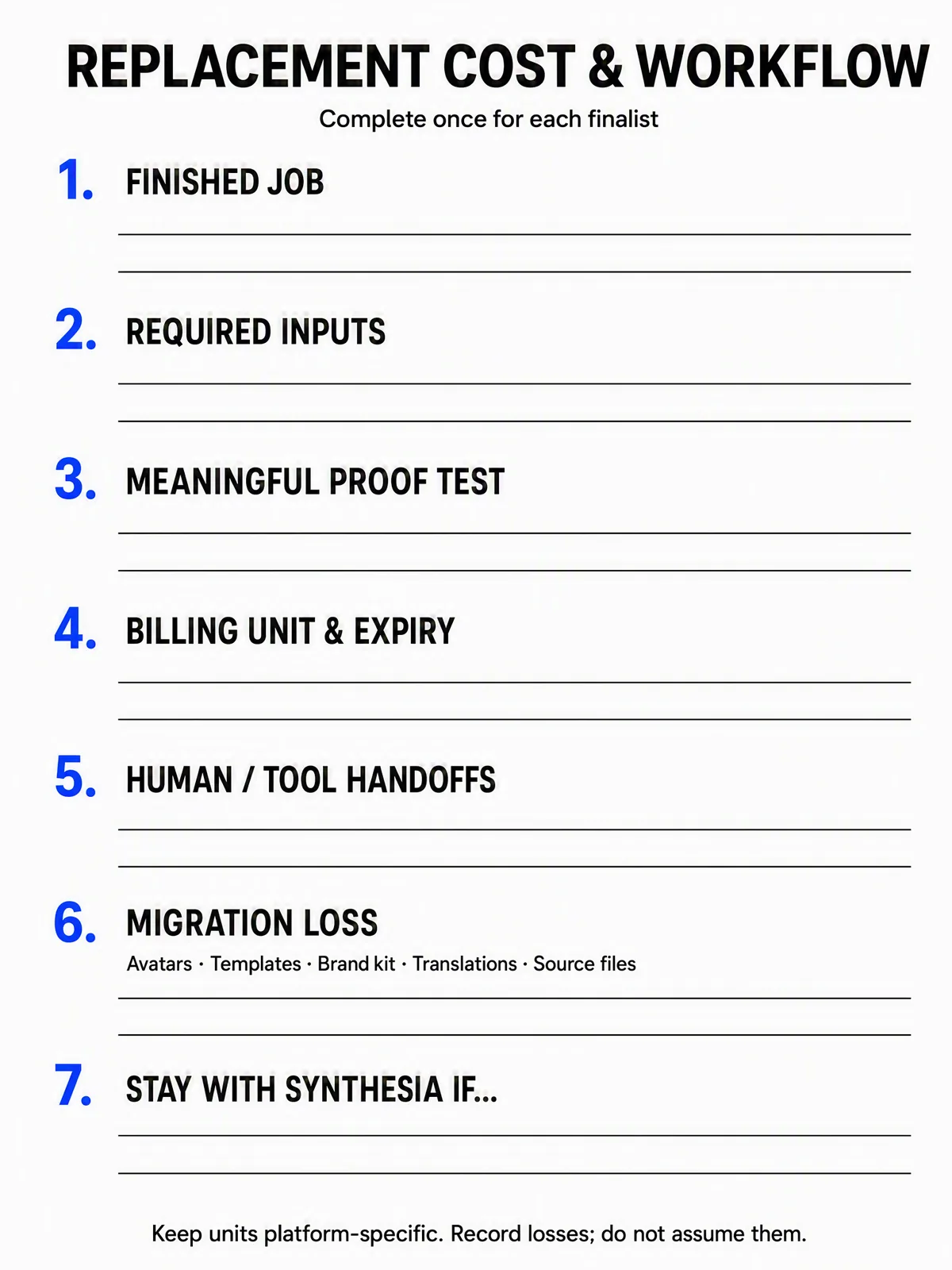
Blank planning worksheet. The table provides a filled example; neither is an interactive calculator or a claim that the proposed test has been run.
Compare the completed package, not the cheapest line item
Suppose two hypothetical production routes deliver the same accepted package. Route A costs $80 in tools and usage plus five hours of human work at $40/hour: $280 total. Route B costs $120 in tools and usage plus two hours at the same rate: $200 total. The route with the higher tool cost is cheaper for that package, provided both meet the same quality and delivery requirements.
Now add a one-time $120 setup and handoff cost for Route B. Its first package costs $320, which is $40 more than Route A. If the assumptions hold for a second identical package, cumulative cost becomes $520 for B versus $560 for A. This is a planning illustration, not a vendor savings claim. Include subscription allocation and idle capacity once in the tool-cost input; don't add the same expense again under a different label.
If the outputs are materially different, don't turn that arithmetic into a ranking. A recorded interview, an avatar lesson and a campaign set are not interchangeable units. Compare each against its own required result, including the work that remains outside the generator.
What a successful switch must demonstrate
A pilot should end with the accepted deliverable, a revision that has survived review and a usable handoff to the next person or system. Keep the source files and approval record. Log failed attempts and missing steps as well as the best output, and set a small spending limit before generating.
If the pilot only proves that another platform can make a nice sample, continue evaluating rather than moving the whole library. If it solves the actual bottleneck and the total cost is acceptable, move that workflow with a clear owner and a way to recover the source material. For a product-led campaign, start with your existing brand and product assets in Advibly. For presenter-led training that already works, keeping Synthesia remains a sound decision.
If a product-led creative brief is the job you want to test, generate your first creatives for free with Advibly. Starter-credit output depends on the selected model and settings; it is not a free completed campaign or publishing entitlement.