

The best social media campaign examples give you a mechanism to adapt, not a look to copy. Strip away the famous brand, colors, and copy. What remains should tell you what input made the campaign possible, how one idea became a series of assets, why people distributed it, where it led them, and when the creative needed to change.
This guide reverse-engineers five campaigns into workflows you can use without impersonating the original. The examples cover personalized data, proprietary research, persona-specific proof, employee expertise, and sequential creative. Each one solves a different campaign problem, so the right choice depends less on which campaign you admire and more on which inputs your brand genuinely owns.
Key Takeaways
- Adapt the campaign mechanism, not the famous brand's visual treatment.
- Choose a mechanism your brand can support with real data, evidence, expertise, or product truth.
- Define the distribution loop, useful next action, measurement signal, and refresh trigger before producing the asset family.
The campaign mechanism canvas
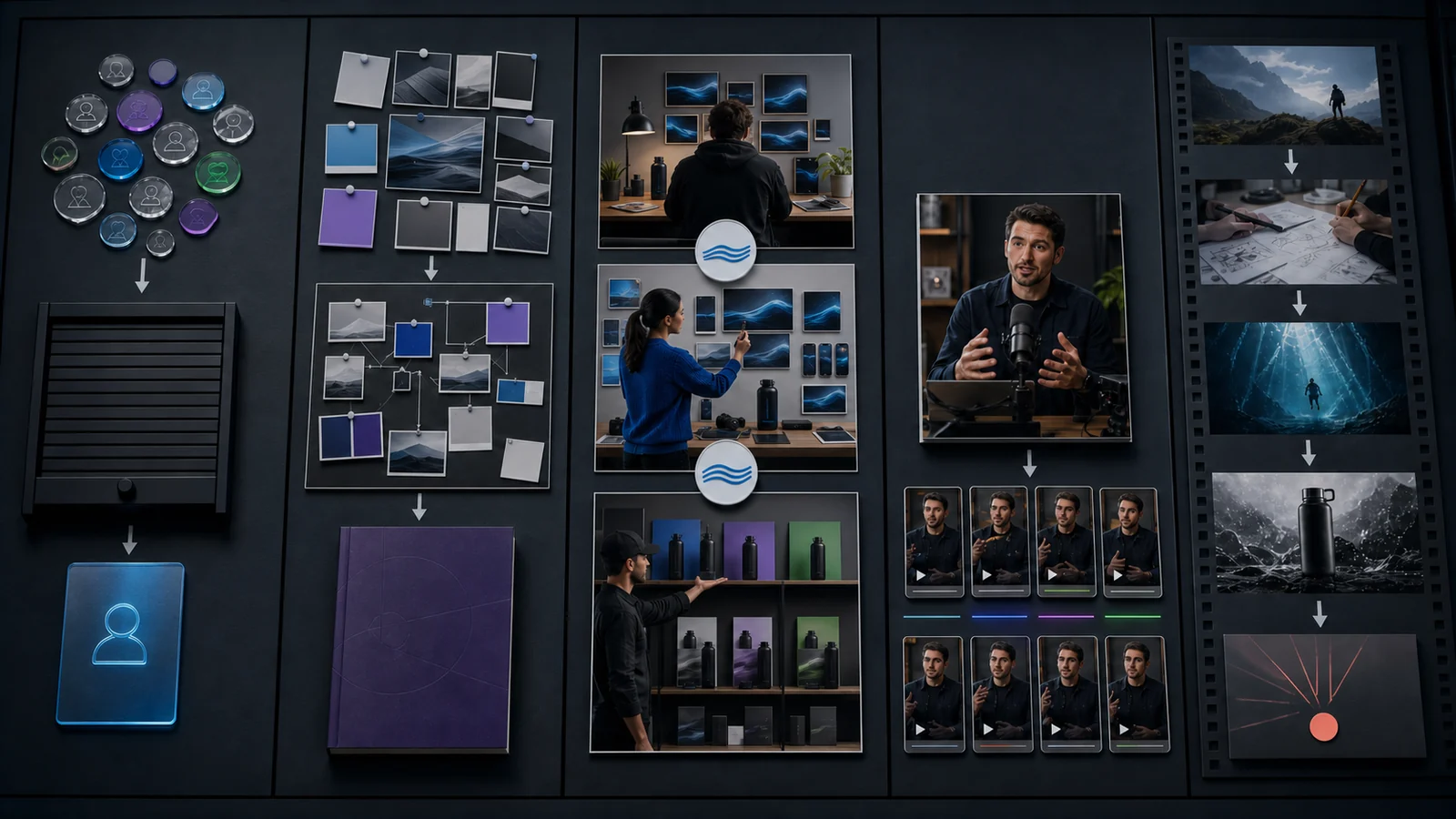
Before adapting any example, map it through seven decisions:
|
Decision |
Question to answer |
|---|---|
|
Audience tension |
What does the audience want to understand, express, prove, or change? |
|
Proprietary input |
What data, evidence, expertise, or product truth can only your brand supply? |
|
Repeatable asset unit |
What is the smallest useful format you can produce more than once? |
|
Distribution loop |
Why would a person, employee, partner, or platform carry the campaign further? |
|
Conversion bridge |
What useful next action follows the content? |
|
Measurement |
Which signal shows progress toward that action, rather than mere exposure? |
|
Refresh trigger |
What evidence tells you to replace the message, proof, audience, or creative? |
This canvas is the depth test. If you cannot fill the proprietary input or distribution loop, you probably have a content format rather than a campaign. If you cannot fill the conversion bridge or measurement row, you have activity with excellent posture.
1. Spotify Wrapped: turn personal data into identity content
Spotify describes Wrapped as a global campaign built around each listener's year in music. The visible output is a sequence of bright, shareable stories. The transferable mechanism is more important: private product usage becomes a user-controlled expression of identity.
The campaign works because the asset is about the participant, not merely about Spotify. Sharing it lets a listener say, “This is who I was this year.” That gives distribution a personal motive.
Workflow to adapt
- Audit the user data you collect, including consent, accuracy, sensitivity, and minimum history.
- Select a few insights that users would find meaningful about themselves. Internal operational metrics do not automatically qualify.
- Translate each insight into a plain identity-led statement.
- Arrange the statements into a short narrative: recognition, surprise, comparison, then recap.
- Create share-safe assets that let the user control what becomes public.
- Publish an owned recap that explains the feature and gives people a clear route to their result.
- Measure result views, voluntary shares, return visits, and the next meaningful product action separately.
Fill this brief:
- Audience tension: “I want to see and share what my activity says about me.”
- Proprietary input: accurate, consented individual history.
- Asset unit: one personal insight card.
- Distribution loop: user chooses to share an identity signal.
- Conversion bridge: return to the product to explore or continue the history.
- Refresh trigger: weak share rate, low result completion, stale insights, or privacy concerns.
Use it when: your product has enough trustworthy user-specific history to reveal something interesting.
Do not use it when: the data is sensitive, sparse, difficult to explain, or more flattering to the company than useful to the user. A Wrapped-shaped graphic without meaningful personal data copies the costume and leaves the mechanism at home.
2. HP and LinkedIn: make proprietary research the campaign spine
In its HP success story, LinkedIn says the two companies co-developed research and distributed it through a report, organic editorial, and paid creative. LinkedIn also reports campaign-specific brand-study results. Those results are not a forecast for another campaign; the reusable lesson is the production system around one defensible body of evidence.
Research-led campaigns work when the finding changes what a buyer believes or does. One flagship conclusion can support a report, a chart, an executive point of view, short social cuts, sales material, and retargeting. The assets stay coherent because they all trace back to the same evidence.
Workflow to adapt
- Write one buyer question that existing advice does not answer well.
- Choose a credible evidence method: first-party product data, a transparent survey, structured interviews, or a documented analysis.
- Identify the finding with the greatest decision value, not merely the largest number.
- Publish the method and limitations beside the finding.
- Build one flagship asset that contains the complete argument.
- Create social units around distinct implications: what changed, who it affects, what to do, and what remains uncertain.
- Give executives or subject-matter experts evidence they can interpret in their own voice.
- Route interested readers to the full evidence before presenting a product action.
- Refresh the campaign when the underlying facts change, not when the date looks old.
Fill this brief:
- Audience tension: “I need evidence for a decision, not another opinion.”
- Proprietary input: a defensible dataset or expert study.
- Asset unit: one finding plus its practical implication.
- Distribution loop: experts and buyers discuss evidence relevant to their work.
- Conversion bridge: report, methodology, related product workflow, or qualified conversation.
- Refresh trigger: new data, a material market change, or evidence that the central finding no longer holds.
Use it when: your team can contribute evidence competitors cannot reproduce by rewriting public advice.
Do not use it when: the “research” is an opaque poll, a tiny sample dressed as market truth, or a collection of statistics borrowed from other publishers. The campaign's authority cannot exceed its method.
3. Atlassian Confluence: keep one idea, change the proof by persona
A LinkedIn case study on Atlassian's Confluence campaign describes a high-concept brand video supported by persona-specific creative for marketers, project managers, and developers.
The mechanism is not “make three versions.” It is “hold the category idea constant while changing the consequence and proof.” A marketer, developer, and agency owner may all recognize the same product promise, but they should not receive the same reason to believe it.
This is the hardest campaign decision in the set because shallow personalization is easy. Changing a job title, opening line, or stock photo does not create a persona-specific argument. The proof must change.
Workflow to adapt
- Name the shared misconception or unresolved problem across all target roles.
- Write one umbrella idea that corrects it without depending on role-specific language.
- For each persona, define the distinct stakes: what goes wrong, what improves, and what evidence matters.
- Assign one proof unit to each persona. This might be a workflow, product screen, use case, constraint, or result you can substantiate.
- Produce a master asset that establishes the shared idea.
- Produce persona cuts that preserve the idea but replace the stakes, proof, and next action.
- Route each cut only where the audience definition is credible.
- Compare qualified actions by persona and proof, not just views by creative.
|
Layer |
Founder |
Marketer |
Agency |
|---|---|---|---|
|
Shared idea |
One approved product context can support a campaign system |
One approved product context can support a campaign system |
One approved product context can support a campaign system |
|
Distinct stake |
Launch without building a large production function |
Turn a brief into channel-ready formats |
Keep several brands separate while producing efficiently |
|
Proof to show |
Source-to-launch workflow |
Static, carousel, and video family from one brief |
Separate brand context and review paths |
|
Useful next action |
See the launch workflow |
Inspect the asset family |
Review the multi-brand process |
The table is a hypothetical adaptation, not a report of campaign performance. Its purpose is to show how the proof changes while the central idea stays intact.
Fill this brief:
- Audience tension: “This category promise sounds broad; show me why it matters in my job.”
- Proprietary input: role-specific product proof.
- Asset unit: one persona claim paired with one relevant proof.
- Distribution loop: precise audience routing and role-relevant sharing.
- Conversion bridge: the next product view or demonstration for that role.
- Refresh trigger: a segment attracts attention but not qualified action, or its proof does not survive review.
Use it when: the same product serves several roles for meaningfully different jobs.
Do not use it when: you cannot name distinct stakes and proof. In that case, one strong campaign is better than three labels standing near the same claim.
4. Dreamdata: build an always-on campaign from employee expertise
LinkedIn's Dreamdata case study describes an employee advocacy program built around employees speaking in their own voices, with selected content amplified through Thought Leader Ads. The company made the program a permanent part of its go-to-market work.
The reusable mechanism is a voice network: recurring customer questions are routed to people with direct expertise, turned into native content, and fed back into the editorial calendar. The company supplies support and distribution without flattening every contributor into one corporate script.
Workflow to adapt
- Identify a small number of expertise lanes tied to real customer questions.
- Match each lane to a willing employee who can speak from direct knowledge.
- Capture questions from sales calls, support conversations, product work, and community discussion.
- Interview the employee or help shape a draft without inventing their experience.
- Record and approve a short native video or post in that person's voice.
- Publish from the person where appropriate, then amplify selectively.
- Feed comments and follow-up questions into the next production cycle.
- Measure qualified conversation, profile-to-site movement, assisted actions, and topic resonance separately from raw reach.
Fill this brief:
- Audience tension: “I trust practitioners who understand the problem better than polished brand copy.”
- Proprietary input: real employee expertise and a repeatable point of view.
- Asset unit: one direct answer from one named expert.
- Distribution loop: employee network, peer relevance, and selective paid amplification.
- Conversion bridge: deeper guide, product explanation, event, or conversation.
- Refresh trigger: repeated questions change, the contributor's expertise shifts, or the content stops producing relevant discussion.
Use it when: your company has willing experts, editorial support, and an approval process that protects rather than erases individual voice.
Do not use it when: the plan depends on synthetic employees, fabricated customer testimony, or scripts contributors would never say. AI can help organize or edit genuine expertise. It cannot manufacture the human source and keep the word “authentic.”
5. Mobily 5G: sequence education before the direct offer
A LinkedIn case study on Mobily's 5G campaign describes five sponsored videos rotated to reduce fatigue, followed by ads retargeting people who had engaged. The document reports results against campaign and local benchmarks, but those figures are platform-published and specific to the stated market, targeting, spend, and execution.
The adaptable mechanism is sequential creative. Awareness assets answer different parts of the story. Engagement identifies a more informed audience. Retargeting then uses simpler proof or a direct offer instead of forcing education and conversion into every post.
Workflow to adapt
- List the questions a buyer must resolve before a direct offer makes sense.
- Give each question its own short creative angle.
- Rotate several assets so one explanation does not carry the entire awareness job.
- Define meaningful engagement before launch. A brief accidental view should not automatically signal intent.
- Build a retargeting audience from the strongest available behavior and applicable consent.
- Show that audience simpler product proof, a demonstration, or a direct next step.
- Compare downstream qualified action by awareness angle.
- Replace the weakest or most fatigued creative while preserving useful learning.
Fill this brief:
- Audience tension: “I need context before I can judge this offer.”
- Proprietary input: a product story with distinct education questions and credible proof.
- Asset unit: one awareness question answered by one creative.
- Distribution loop: paid rotation followed by behavior-based sequencing.
- Conversion bridge: demonstration, offer, trial, or sales path after sufficient context.
- Refresh trigger: falling completion, weak qualified retargeting pools, repeated exposure, or poor downstream action.
Use it when: a launch or unfamiliar product needs education before conversion creative can work.
Do not use it when: you lack the media setup, consent, traffic, or measurement needed to operate a sequence. A set of five videos published at random is not a funnel.
How to choose the right campaign mechanism
Choose the example whose required input you already possess or can responsibly create.
|
If you have… |
Start with… |
Main risk |
|---|---|---|
|
Trustworthy individual usage history |
Personalized identity content |
Privacy, weak data, or forced shareability |
|
A defensible dataset or study |
Research-led campaign |
Methodological weakness or overstated findings |
|
One product used differently by several roles |
Persona-specific proof |
Cosmetic rather than substantive variants |
|
Willing experts with clear points of view |
Employee voice network |
Over-scripting or fabricated authenticity |
|
A product that requires education before action |
Sequential creative |
Weak targeting, consent, or attribution |
Fame is not a selection criterion. The useful question is: can your brand supply the proprietary input and operate the feedback loop? If not, choose a simpler mechanism.
A worked adaptation for a SaaS launch
Suppose a SaaS company is launching in August to founders, marketers, and agencies. It has clear product workflows for each audience but no proprietary market study, large user dataset, or established employee advocacy program.
The persona-specific mechanism is the strongest fit because the company already owns the required input: different product proof for each segment.
- Shared misconception: creative production requires rebuilding context for every format and campaign.
- Umbrella idea: save approved product context once, then use it across a campaign.
- Founder proof: show a short path from a website source to a launch asset set.
- Marketer proof: show one brief becoming a static, carousel, and short video.
- Agency proof: show separate brand context and outputs for different clients.
- Master asset: one short video establishing the repeated-context problem.
- Persona cuts: three statics, each using the proof its audience needs.
- Supporting asset: one carousel explaining the shared workflow.
- Conversion bridge: route each segment to the matching product demonstration or signup path.
- Measurement: track qualified product visits and signup or activation signals by segment. Treat views and clicks as diagnostic steps, not the business result.
This is a campaign plan only after the claims, product screens, audience routing, review owner, and measurement definitions are approved. Until then, it is a useful creative brief.
When manual creative direction is the better choice
A strategist and channel specialist are the stronger alternative when the mechanism is still unresolved. They can investigate the audience, decide which proprietary input is credible, shape the offer, plan media, and define measurement before production begins.
Use manual direction first when:
- you do not know which audience tension matters;
- the campaign depends on research you have not conducted;
- persona differences are assumptions rather than observed jobs;
- employee or customer participation is not confirmed;
- channel targeting, consent, or attribution needs specialist design;
- the product claim itself still needs validation.
A creative generator becomes useful after these decisions exist. Faster production cannot rescue a campaign whose premise is wearing borrowed shoes.
Turn the mechanism into an asset system
Once the campaign mechanism, evidence, and audience decisions are approved, production becomes a structured translation job. Advibly can use saved website, app, store, screenshot, and brand context to produce campaign assets across statics, carousels, posts, and short video. Its creative skills package repeatable production workflows, and publishing tools can carry approved content into a calendar.
The boundary matters. Advibly can help turn a campaign system into a consistent asset family. It does not create trustworthy customer data, proprietary research, authentic employee testimony, media targeting, or causal measurement. If those inputs are missing, resolve them before generation.
A practical handoff into production should contain:
- the chosen campaign mechanism;
- the audience tension and exact segment;
- approved evidence and prohibited claims;
- the repeatable asset unit and required formats;
- real product or brand references;
- the distribution and conversion path;
- the review owner;
- the measurement definition and refresh trigger.
That brief gives a human team, an agent workflow, or a creative skill enough structure to produce variants without confusing volume for a campaign.
Sources
- Spotify Newsroom: How Our 2025 Wrapped Campaign Turns Your Year in Listening Into a Global Celebration
- LinkedIn Marketing Solutions: HP Success Story
- LinkedIn Marketing Solutions: Atlassian builds brand awareness with LinkedIn CTV Ads
- LinkedIn Marketing Solutions: Dreamdata, cutting through B2B content overload with employee voices
- LinkedIn Marketing Solutions: Mobily 5G campaign
- Advibly and Advibly Skills