

Instagram influencer marketing works when a creator's trust and a brand's commercial objective meet in content the audience would still choose to watch. It fails when teams start with a follower count, skip rights and disclosure, or treat one post as the campaign.
The operating job has six parts: choose the outcome, select creators for audience fit, agree deliverables and rights, brief without flattening the creator's voice, produce supporting assets, and measure what happened.
Key Takeaways
- Pick one primary objective, awareness, consideration, conversion or creative learning, and let that single job set the creator brief, the call to action and the measurement window.
- Choose creators for audience fit and content credibility, not follower count, and ask for recent audience and content evidence before committing budget.
- Price the full cost model (fee, usage rights, production, paid distribution, internal operations), and negotiate ad-usage rights before the post is produced.
- Disclosure must be clear, conspicuous and present in the video itself when the endorsement is a video, not only in the caption; a platform label does not remove the advertiser's responsibility.
Start with the decision the campaign must change
|
Objective |
Useful creator behaviour |
Primary measure |
|---|---|---|
|
Awareness |
Demonstrate or narrate a memorable product truth |
Qualified reach, video completion, profile visits |
|
Consideration |
Show the product in a credible routine and answer objections |
Saves, shares, landing-page visits |
|
Conversion |
Make the offer, next step and proof unmistakable |
Attributed visits, codes, trials or purchases |
|
Creative learning |
Test hooks, formats and claims for later brand use |
Reusable winning patterns with usage rights |
Do not ask one post to optimise all four. The creator brief, CTA and measurement window should reflect one primary job.
Choose creators for fit, not reach alone
Meta's Creator Marketplace is designed to help brands discover and evaluate creators and build partnership campaigns. Regardless of the sourcing method, review audience geography, topic consistency, comment quality, prior sponsorships, production reliability and whether the creator can demonstrate the product naturally.
A smaller relevant audience can be more useful than a larger general one. Ask for recent audience and content evidence, not just a media-kit headline.
Build the real cost model
There is no honest universal price per influencer. A working budget separates the fee from everything around it:
|
Cost |
What changes it |
|---|---|
|
Creator fee |
Audience, format, production effort, category and exclusivity |
|
Usage rights |
Duration, territories, organic use and paid amplification |
|
Production |
Location, props, editing, reshoots and product logistics |
|
Paid distribution |
Media budget and partnership-ad setup |
|
Internal operations |
Sourcing, contracts, reviews, reporting and asset adaptation |
Compare cost per approved deliverable and cost per useful outcome, not fee per follower. If the brand wants to reuse the creative in ads, negotiate those rights before the post is produced.
The creator brief: protect truth without scripting personality
A useful brief fits on one page. Include the audience problem, one required product truth, available proof, the desired action, format and duration, prohibited claims, mandatory disclosure, deliverables, due dates, review stages and usage rights. Then leave room for the creator's hook and language.
Good constraint: show how the product fits into your real editing workflow and mention the approved time-saving feature. Bad script: recite six benefits in the brand's landing-page voice.
Disclose clearly
The US FTC says material relationships must be disclosed clearly and conspicuously. A disclosure should be hard to miss, placed with the endorsement, and, when the endorsement is in video, present in the video rather than only in the caption. Meta also provides branded-content and partnership tools. Teams should follow the rules that apply to their market and platform; a platform label does not remove the advertiser's responsibility.
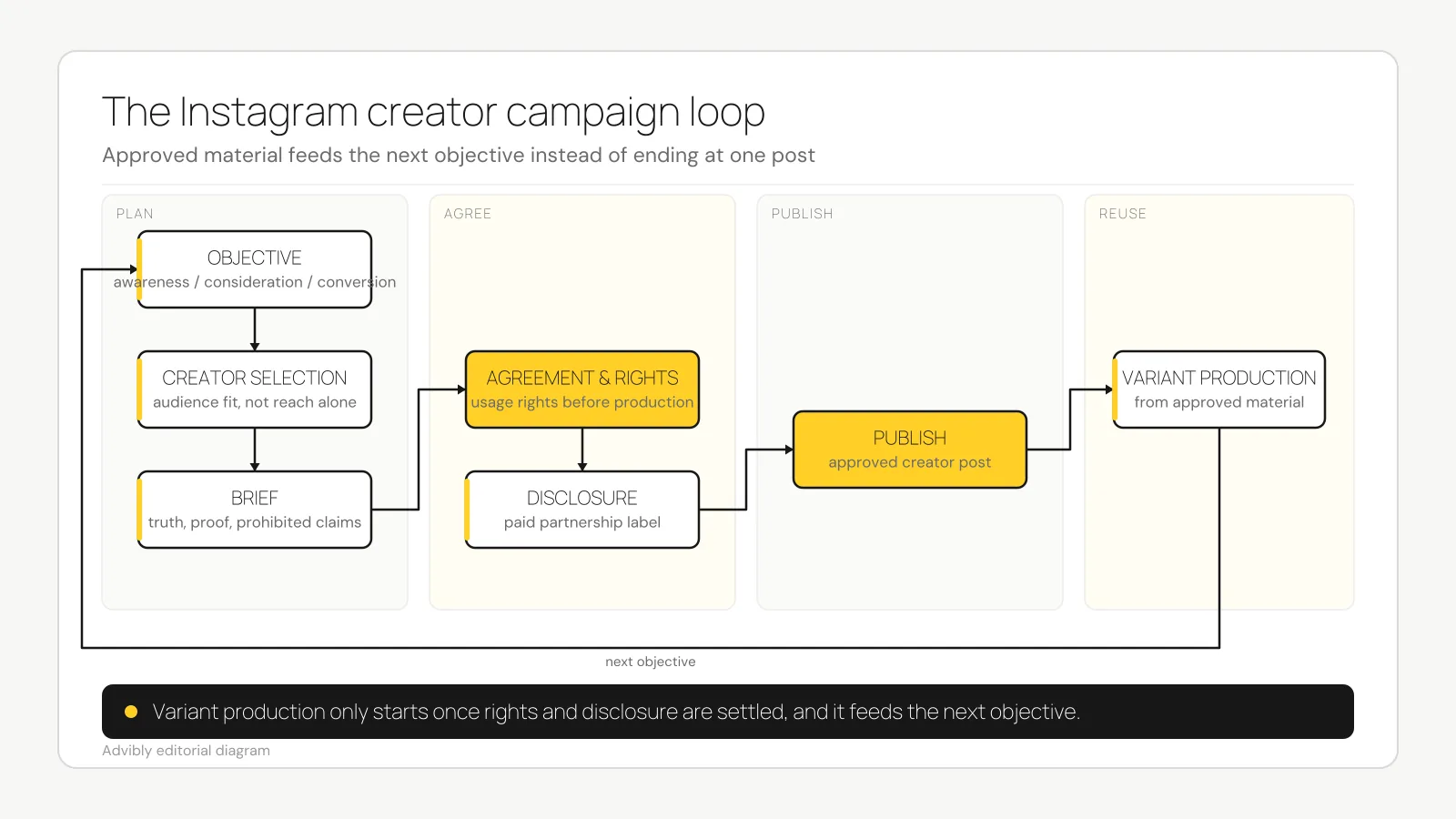
Turn one collaboration into a campaign system
- Keep the approved creator post as the source asset.
- Extract the strongest hook, objection and proof.
- Create brand-owned cut-downs only within the agreed usage rights.
- Turn the message into static ads for feed and story placements. Rebuild the same proof as carousels for saves and shares. Reuse the language in captions and landing-page copy.
- Record which element produced the response: creator, hook, product moment, offer or format.
Advibly can support this production layer once rights are settled. It keeps product and brand context together in one brand kit. From there, it turns the approved material into multiple marketing formats. It does not source creators, negotiate contracts, publish under a creator's identity or grant usage rights. That boundary should remain explicit.
A pre-launch checklist
- One primary objective and measurement plan
- Audience and creator-fit evidence
- Written deliverables, review points and rights
- Approved product claims and prohibited claims
- Clear disclosure placement
- A plan for brand-owned variants after approval, drawn from the format skills already cleared for use
Use Advibly for the campaign creative layer once the creator strategy and rights are settled.
Sources
- Meta Creator Marketplace, accessed 4 August 2026.
- FTC Disclosures 101, accessed 4 August 2026.
- Instagram branded-content guidance, accessed 4 August 2026.