

Facebook ad optimization is not the act of making more ads. It is the discipline of changing a meaningful variable, reading the result in Meta, and using that evidence to decide the next creative batch. When every execution changes at once, optimization becomes a stream of opinions attached to fluctuating numbers.
Advibly can support the production side of this loop. Meta Ads Manager remains the authority for campaign delivery and measured performance.
Key Takeaways
- Facebook ad optimization means changing one meaningful variable per test, not producing more ads at once, so the result can actually be read.
- Test at the right level of the ladder: go higher (value proposition, proof) when the message itself is uncertain, and lower (execution, format) once the proposition is proven.
- A controlled batch keeps audience, offer, landing page, product and visual system invariant while only the tested variable changes.
- Record each result with its delivery context, magnitude and confidence in a learning log, then decide to exploit the winner, replicate it or test the next level.
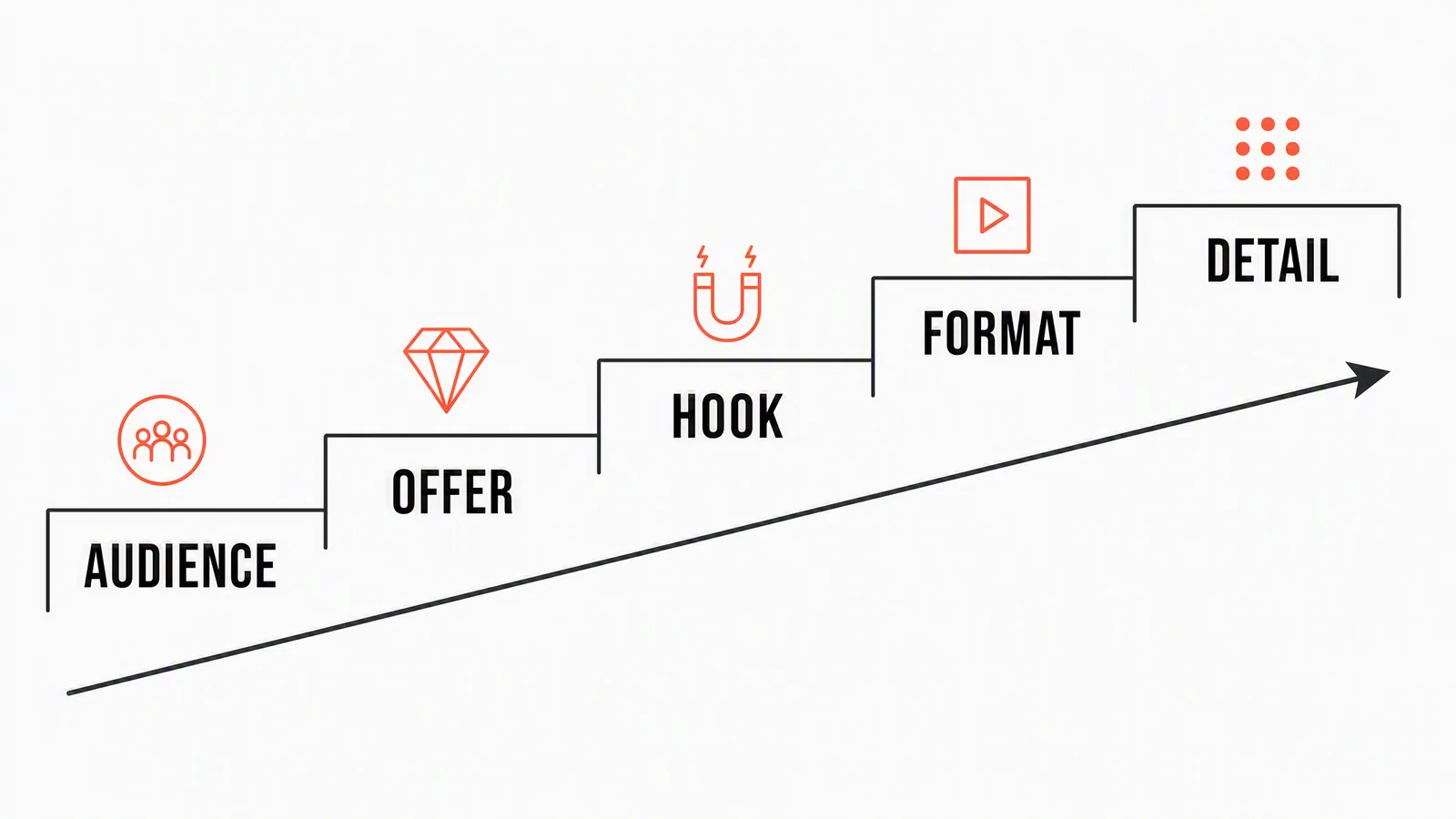
Use a test ladder
|
Level |
Question |
Example variable |
|---|---|---|
|
Value proposition |
Why should this audience care? |
Save time vs reduce uncertainty |
|
Proof |
What would make the promise believable? |
Product demonstration vs qualified customer quote |
|
Concept |
What story makes the value concrete? |
Before-and-after moment vs guided workflow |
|
Execution |
How should the concept appear? |
Product close-up vs contextual scene |
|
Format |
What medium explains it best? |
Static vs carousel vs short video |
Test higher on the ladder when the message itself is uncertain. Test lower when the proposition is proven and the team is refining presentation.
A worked creative test
A subscription coffee brand wants to improve qualified trial starts. Its approved proposition is fresh coffee matched to taste. Keep audience, offer, landing page, product and visual system stable. Change only the proof mechanism:
- A three-question taste-matching interface.
- A transparent example of the resulting recommendation.
- A qualified customer quote about avoiding random purchases.
- A side-by-side explanation of roast and flavour preferences.
The test asks a real question: which proof helps a new buyer believe that matching will be useful? It does not ask whether blue, a testimonial, a different headline and a larger product photo happen to win together.
Build the batch before touching the campaign
- Write the hypothesis in one sentence.
- Name the variable that changes.
- List the elements that must remain invariant.
- Create the minimum set of variants that can answer the question.
- Review product truth, claim proof and crop safety.
- Use clear filenames or IDs so the creative can be reconciled with Meta results.
Read results without inventing causality
A winning result is evidence from a specific audience, campaign setup, period and spend level. It is not a timeless law about all coffee buyers. Record the delivery context, the magnitude of the difference, and whether there was enough data to justify action. Then decide whether to exploit the winner, replicate the result or test the next level.
|
Log field |
Example |
|---|---|
|
Hypothesis |
Showing the matching mechanism will reduce uncertainty better than social proof |
|
Changed variable |
Proof type |
|
Invariant elements |
Audience, offer, layout system, CTA and landing page |
|
Measured result |
Record directly from Meta with date and attribution setting |
|
Interpretation |
What the result suggests, not what it proves universally |
|
Next test |
Replicate the strongest proof in video or test a new value proposition |
Creative diversification without random variation
Meta recommends a mixed-format strategy and offers Advantage+ creative tools for tailoring and adapting assets. Automation can increase the number of executions. A testing plan is what turns that range into learning.
Where Advibly fits
Advibly can preserve product and brand context, generate controlled static, carousel and video variants, and make the set reviewable before connected publishing. It does not replace Meta's campaign controls, reporting or attribution. A clean integration is directional: measured learning enters the next brief; production does not invent performance conclusions.
A weekly operating rhythm
- Monday: review settled results and choose one question.
- Tuesday: produce and approve the controlled batch.
- Wednesday: launch with the intended Meta setup.
- During the run: monitor delivery health without rewriting the hypothesis mid-test.
- After sufficient evidence: record the result and queue one next action.
Produce controlled Facebook creative variations in Advibly.
Sources
- Meta: Expand your ad creative strategy, accessed 4 August 2026.
- Meta Advantage+ creative, accessed 4 August 2026.
- Meta Ads Manager campaign guidance, accessed 4 August 2026.
- Advibly AI image ads, checked 4 August 2026.