

Branded content is useful when the audience receives a story, demonstration or piece of expertise, not merely a product mention wearing editorial clothes. The brand is present, but attention is earned by the format.
The term also carries a specific platform meaning. Meta describes branded content around an exchange of value between a creator or publisher and a business partner. That is different from a brand publishing its own content, even though both need accurate claims and a recognisable point of view.
Key Takeaways
- Branded content earns attention through its format, a guide, demonstration, creator story, behind-the-scenes look or series, not through a product mention dressed as editorial.
- Meta's branded content label applies specifically to a paid or value exchange with a creator or publisher; brand-owned content follows a different rule but the same accuracy standard.
- Disclosure, usage rights and approval routing are production fields to lock before scale, not notes to add at the end.
- A repeatable workflow separates the hero asset from its adaptations, so one approved idea can serve a guide, a demonstration and a short-video format without rebuilding the input each time.
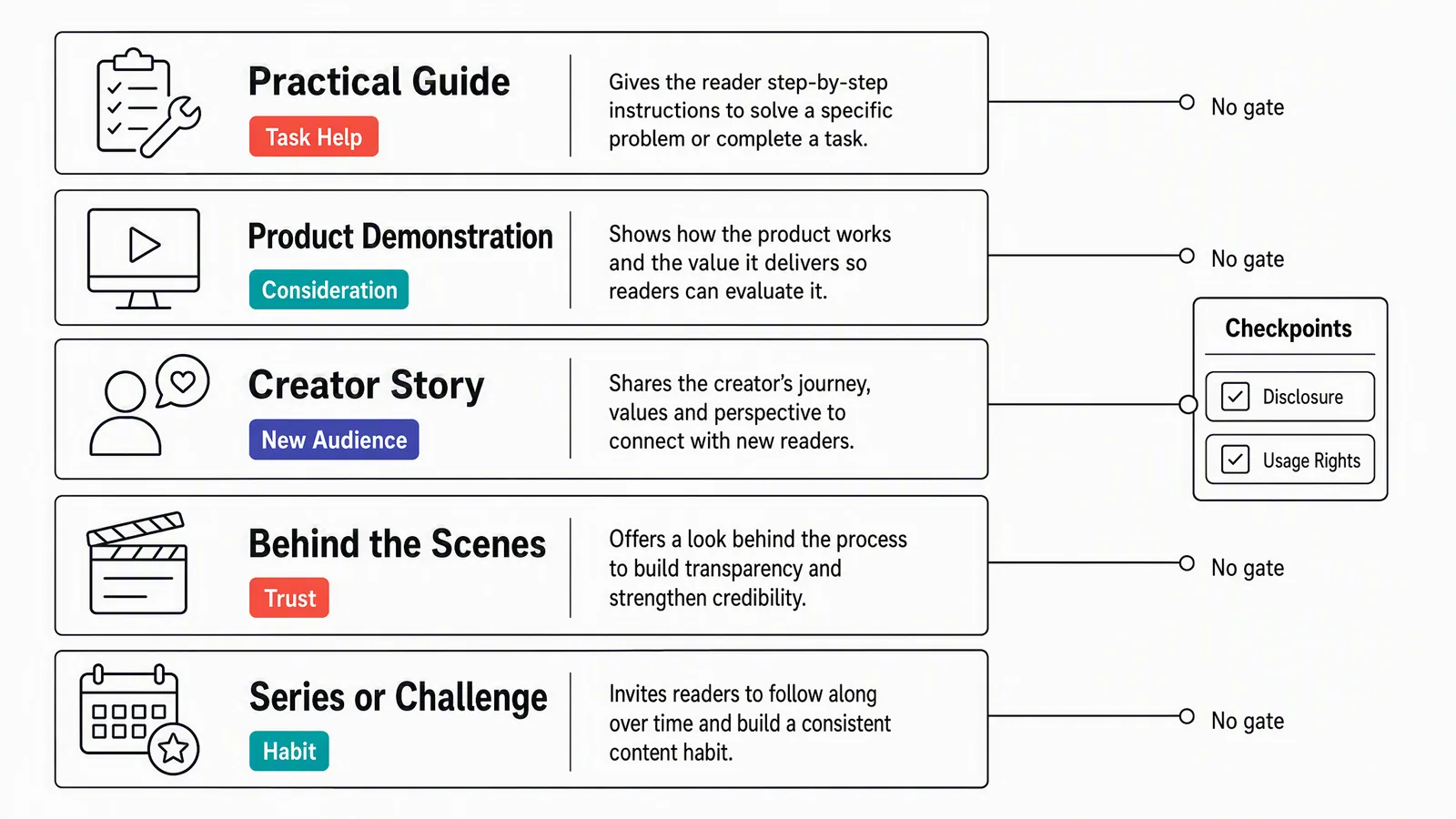
Choose the format by the audience job
|
Format |
Audience value |
Best use |
|---|---|---|
|
Practical guide |
Helps someone complete a task |
Category education and search discovery |
|
Product demonstration |
Shows how something works in context |
Consideration and objection handling |
|
Creator story |
Adds lived perspective and trust |
New audience access and social proof |
|
Behind the scenes |
Makes the process visible |
Trust, craft and employer brand |
|
Series or challenge |
Creates a repeatable reason to return |
Habit, community and campaign continuity |
The format is not the idea. "Make a carousel" is a production instruction. "Show three decisions that turned a failed launch into a useful campaign" is a reason to pay attention.
Three examples of strong content architecture
1. The useful demonstration
Start with the problem in the viewer's environment, show the product changing one part of the workflow, and end with evidence or a decision. Avoid a feature parade. One honest constraint can make the demonstration more credible.
2. The expert teardown
Analyse a real creative, brief or campaign using a clear rubric. The brand earns authority by making the reader smarter. The product can appear where it helps execute the recommendation.
3. The creator-led field test
A creator uses the product in a real routine, names what worked and what did not, and discloses the relationship. The brand supplies approved truth and guardrails; the creator supplies voice and experience.
Governance comes before scale
When there is a material relationship, the FTC says the connection should be disclosed clearly and conspicuously. On Instagram, use the platform's branded-content or partnership tools when applicable. Separately document usage rights, paid amplification, territories, duration, music, claims and the final approver.
- Is the relationship disclosed where people will notice it?
- Does every product statement have approved evidence?
- Can the brand legally reuse the asset in ads?
- Is the creator's likeness or voice licensed for that use?
- Who can approve edits after publication?
A repeatable production workflow
- Write the audience promise. What will someone understand, feel or be able to do?
- Lock product truth. Store approved source material, logos, product facts and prohibited claims.
- Choose a native format. Design for the channel rather than cropping an all-purpose master.
- Produce a hero asset. Solve the idea before multiplying variants.
- Adapt deliberately. Reframe the hook, crop, pacing and CTA for each placement.
- Review rights and disclosure. Treat them as production fields, not last-minute notes.
- Record the learning. Save the hook, proof and format that changed behaviour.
Where Advibly fits
Advibly supports the brand-owned production layer: product sources and reusable context can stay together while a team creates static ads, product visuals, carousels, posts and several video formats. It can help adapt an approved idea without rebuilding the input each time. It does not create an endorsement, supply creator rights or make a disclosure decision for the business.
Create a multi-format branded-content workflow with Advibly.
Sources
- Meta: branded content on Instagram, accessed 4 August 2026.
- FTC Disclosures 101, accessed 4 August 2026.